
If you have thought about trying to run on your local trail, you're not alone. Participation in trail running, according to the Outdoor Industry Association's 2026 Running Report, has grown 57% since 2019 and is up just over 6.6% since last year. And 80% of the new trail runners came from road running. So question you may be asking yourself is how do I choose the Best Trail Running Shoe for me?
Trail running participation is up 57% since 2019. Before you buy, learn the 3 key attributes — terrain, waterproofing, and cushion — that actually matter.
Why Trail Running Is Booming
Why are these numbers important? Because brands track these numbers very closely, and when they see a rise in participation, they invest in more trail shoes. That's why there are more choices today than there have ever been.
There has never been a better time to get into trail running, with so many choices ranging from well-known brands adding trail shoes to their line — like Brooks, who last year added a trail version, the Brooks Ghost Trail, of one of the industry's most trusted shoes, the Brooks Ghost — to new entrants like Nnormal, who are bringing something new to the table with a responsive feel and clean aesthetics in the Cadi.
But with all these new brands and shoes, the choices can be overwhelming. As always, we recommend you take our fit test to properly match your biometrics (weight and foot shape) with your preferences and goals to find the perfect shoe for you.
Without further ado, let's get into the 3 most important attributes to consider when choosing the best trail running shoes for you.
1. Terrain
This is the single most important thing to consider. Understanding the terrain helps you understand what traction/grip you will need. Not enough traction on your shoes and you are liable to slip and fall, and depending on the terrain, that could be a serious or even life-threatening injury. Too much grip and the shoe will feel hard and heavy. Shoes are broken down into three main categories:
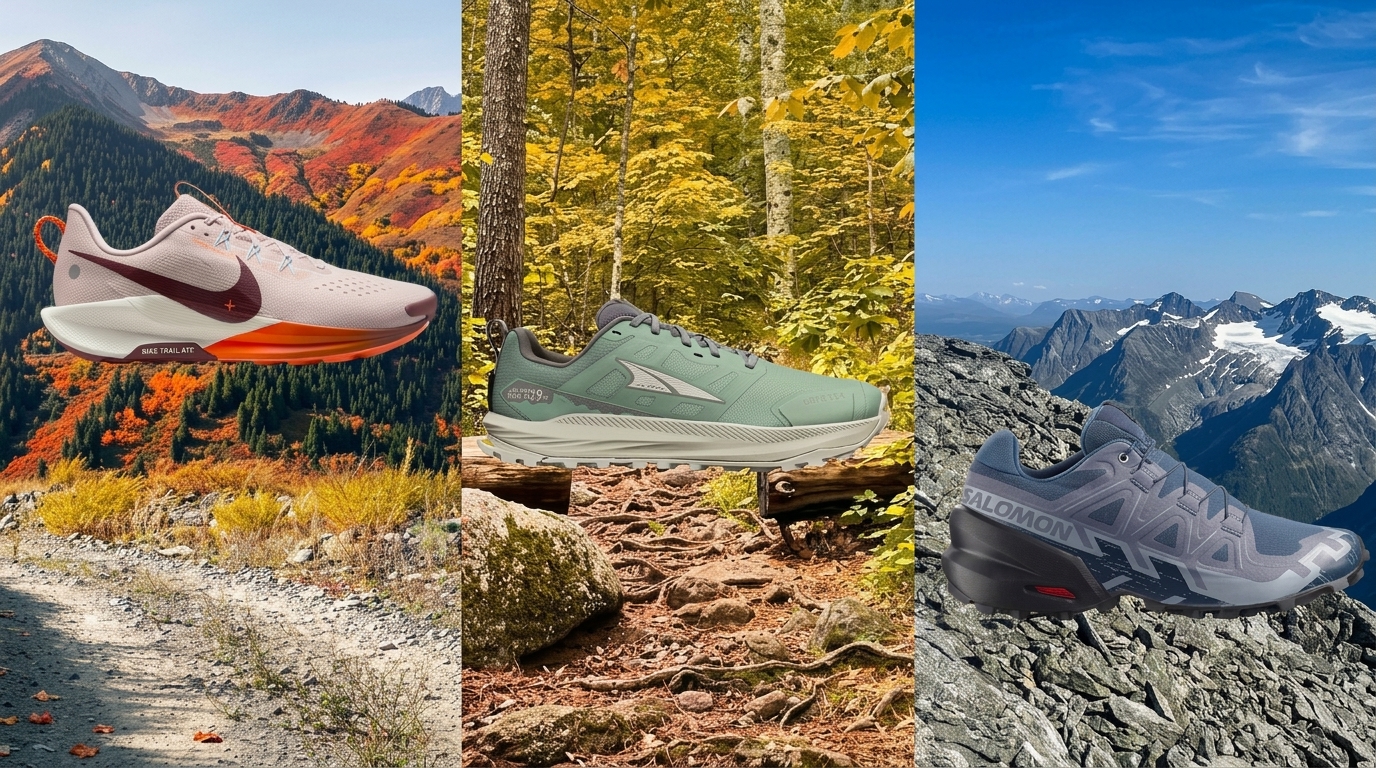
A) Paved Path — Often called "road to trail" or "door to trail" shoes, these are road shoes that receive a little extra traction/rubber on the bottom of the shoe and sometimes have a more abrasion-resistant material on the upper to fend off dirt. Choose this type of shoe if you'll be on packed trail/fire lanes and want a shoe you can use for both road and trail. A great example of this type of shoe is the On Cloudsurfer Trail (women's).
B) All Terrain — Exactly what it says in the name: a great shoe for multiple trail terrains. The important difference from a "road to trail" shoe is that all-terrain shoes were built from the ground up as trail running shoes, unlike "road to trail" shoes that started as road shoes and were given some trail attributes. You'll notice all-terrain shoes typically have 3–5mm lugs vs. the 1–3mm on road-to-trail shoes. The drop is also often lower, since your gait changes on uneven surfaces — people tend to forefoot/midfoot strike because they're not on even ground. A great example is the Altra Lone Peak (women's) or the Hoka Speedgoat (women's).
C) Technical — This terrain is exactly what the word describes: it requires a degree of technical approach as much as just running. The terrain is often extremely rocky and exposed to the elements, making rock faces treacherous with ice, snow, or moisture. Technical shoes in this category have overly aggressive lugs, fit closer to a racing shoe to prevent movement inside the shoe, and have aggressive toe protection. One of the core shoes in this category, and long-standing king, is the Salomon Speedcross 6.
2. Waterproofing
Second, you'll notice that most trail running shoes come in two options: waterproof and regular. There are trade-offs — waterproof will keep your feet dry, but at the cost of breathability: it doesn't let sweat escape, and once the shoe does get wet, there's nowhere for that moisture to escape, so it gets trapped and takes a long time to dry. Most serious runners opt for the regular version for better breathability.
3. Cushion
Lastly, with foams getting lighter and more durable, it's natural that high-cushion product is making its way into the trail space — shoes like the New Balance Hierro v9.
But more cushion on the trail isn't necessarily better. On the road, it's a flat surface, so you can predict how you're going to land and get away with some of the instability inherent in high and max-cushion shoes. On the trail, the ground is uneven, creating an unstable surface — being closer to the ground naturally makes you more stable.
Unless you're running an ultra, leave the higher-cushion product for the road.
There are a lot of trail shoes to choose from when you think about hre right shoe for you and hopefully this article gives you the education to get started on your trail journey to find the Best Trail Running Shoes
The shoe models mentioned above are examples to illustrate each attribute, not recommendations for you specifically. Use this as a framework to be a more informed shopper, but make sure you're still getting properly fit with these factors in mind.
Not Sure Where to Start?
Let our Fit Test match you with a shoe based on how your body moves, your preferences, and your training goals — because a 200lb runner and a 150lb runner shouldn't be wearing the same shoe.
Take the Fit Test