

After 25 years in footwear, here's the framework I actually use: activity, surface, fit, cushioning, feel, and drop — walked through one attribute at a time, with real examples, so you can shop smarter instead of guessing.
Start With Activity
Before anything else, think about how you'll actually use the shoe. Is it strictly for running and walking, or do you want something more versatile — a shoe that can also handle the gym or a HIIT class, like the On Cloud X 5 (women's)?
If it's going to double as a training or gym shoe, stay away from max-cushion running shoes like the Hoka Bondi (women's). That much stack height creates an unstable surface for lateral movement, and it can increase your risk of ankle sprains during side-to-side work. Instead, look for something built on a running last but designed for training — usually a wider base to support lateral movement, like the On Running Cloud X 5 or the Hoka Solimar 2 (women's).
Then Consider Surface
The next piece of how to choose a running shoe is thinking about where you'll actually be running. Mostly road or treadmill? Or are you headed for the trails? There's a shoe built for nearly every condition. If you're doing a mix of both, a hybrid road-to-trail shoe — something like the Salomon Aero Glide 4 GRVL (women's) — can cover you without owning two pairs.
This article focuses on road running. If you're shopping for trail or hybrid use, see our article on how to choose a trail shoe.
Get Fit Right
Fit is one of the biggest factors in how to choose a running shoe you'll actually be happy with. Know your correct size and width — if you haven't measured your feet in the past year, use our measuring guide and size chart to check. Foot shape and support change over time, so it's worth re-measuring even if you've "always worn a 9." If you measure into a wide width, focus your search on models that offer a wide option rather than sizing up in the standard width.
For more on how a running shoe should actually fit on your foot, see our article on how to fit running shoes.
Match Cushioning to Distance
Your weekly mileage should drive how much underfoot cushioning you need:
- 30+ miles a week: You'll generally want more cushioning to absorb repeated impact — something like the Brooks Glycerin 23 (women's).
- Under 30 miles a week: You can often save money with a shoe that has a bit less underfoot cushioning, like the Brooks Ghost 18 (women's), without sacrificing comfort.
Don't Skip Feel
This one gets overlooked, but it's a big part of what makes a shoe enjoyable mile after mile. With all the innovation in foam and midsole material, some shoes feel soft and plush underfoot, while others feel springier — almost trampoline-like. Neither is right or wrong. This comes down entirely to personal preference, and it deserves as much weight as the more technical factors above.
Understand Drop
Drop is the difference between the height of the shoe at the heel and the height at the forefoot. A traditional setup might be 24mm at the heel and 12mm at the forefoot — a 12mm drop. That difference pitches you slightly forward, which can help maintain momentum through your stride. Other brands, like Altra, build shoes with zero drop — the Escalante 5 (women's) and Torin 9 (women's) are two examples — where the heel and forefoot sit at the same height.
Why does drop matter? It relates to how your foot strikes the ground:
- Heel strikers (landing heel-first) typically do well with a higher drop, which cushions the heel and eases the transition through the stride.
- Forefoot or midfoot strikers (landing closer to the ball of the foot) often prefer a lower or zero drop, since a tall heel stack doesn't match how they land and can feel like it's fighting their stride rather than supporting it.
It's a Lot to Track — That's the Point of Asking
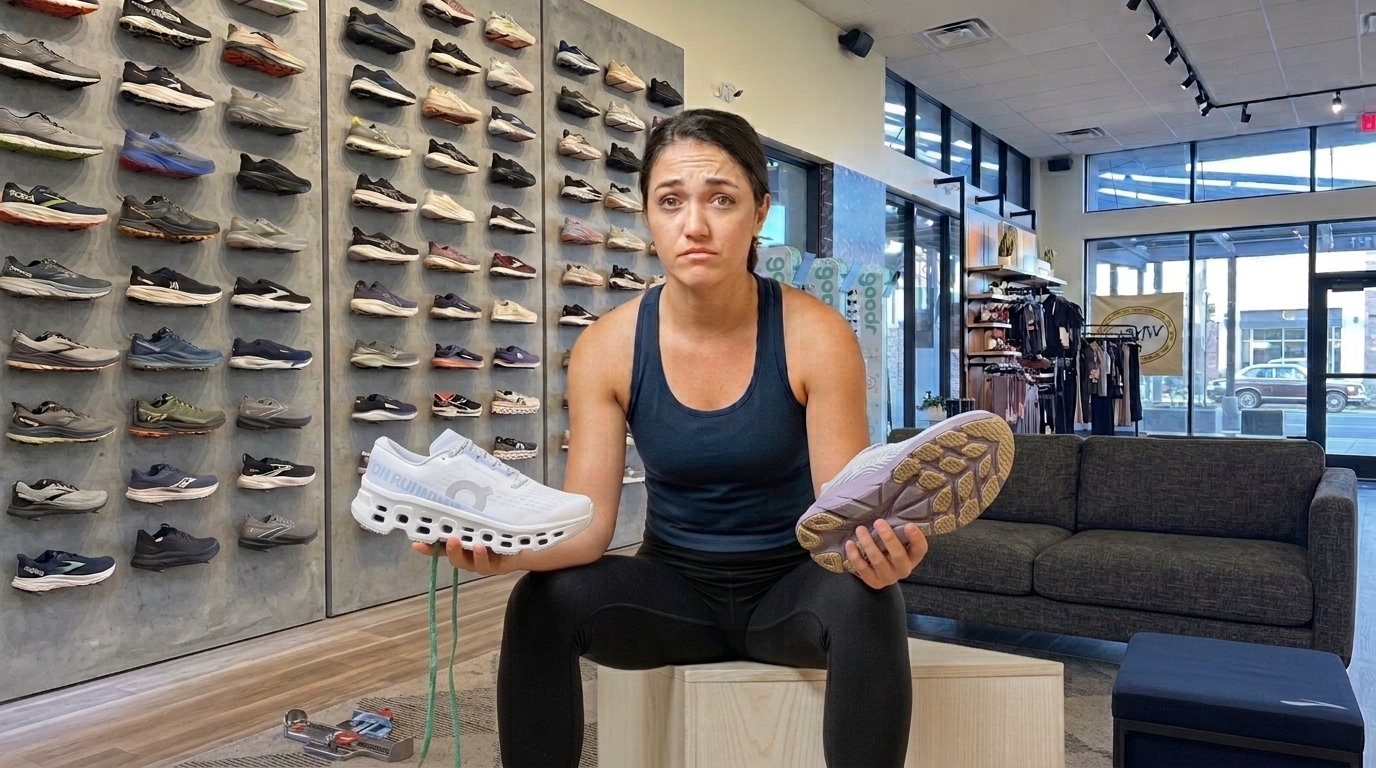
Between fit, feel, drop, cushioning, and activity, keeping all of this in your head while standing in a shoe wall is a lot to ask of any runner — or honestly, of most shoe store employees too. The shoe models mentioned above are examples to illustrate each attribute, not recommendations for you specifically. Use this as a framework to be a more informed shopper, but make sure you're still getting properly fit with these factors in mind.
If you take away one thing from this article, let it be comfort. Multiple studies over the last decade point to comfort — what Nigg termed the Comfort Filter Paradigm — as one of the strongest predictors of reduced injury risk. Whatever feels comfortable on your foot is the right call, regardless of what anyone else tells you should feel comfortable.
That's how to choose a running shoe — attribute by attribute, not by hype. Not sure where to start? Let our AI walk you through the right questions and match you with a shoe that fits how your body moves, what you prefer, and what you're training for.
What you run in matters. Find your shoe match at findmyrunningshoes.com