



When it comes to building the right strength training for runners, let's start with an honest truth: there is no single "magic" list of five or ten strengthening exercises that is perfect for every single runner. Your unique physical structure, training volume, and individual goals will always determine what is best for your body.
Running places massive physical demands on your body with every single step. Skip the gym and build the stability, power, and resilience you need with this simple 6-exercise at-home strength circuit.
Why Running Demands Real Strength
We often take the movement of running for granted because we naturally started doing it when we were kids. Back then, we ran to chase a ball, catch a firefly, or be the first to reach the ice cream truck.
But back then, we also weighed about 50 pounds, ran a few hundred feet at a time, and didn't spend 40 hours a week sitting at a desk.
When you strip away the instinct, running is actually a highly complex, repeated series of single-leg jumps designed to move your body forward.
Every time your foot hits the ground, that single leg must absorb your entire body weight, stabilize your hips, and immediately transition your body forward - only to repeat the exact same series on the opposite side.
At a standard cadence of 180 steps per minute, you will perform this series of events nearly 5,000 times during a casual 3-mile run. That places a huge amount of demand on your muscles and requires a high level of coordination from your body to keep you stable.
There is no workaround for poor functional strength. If you want to run faster, feel lighter, and remain injury-free, targeted strength training is a non-negotiable part of your regimen.
The At-Home Runner's Strength Circuit
The following six exercises are specifically chosen to build capacity in the exact muscles required for running. They require absolutely zero equipment and can be done right in your living room.
Perform 2 to 3 sets of 10 to 12 repetitions of each exercise. Move through them in order as a continuous circuit to build endurance. Aim to perform this circuit of exercises 2 to 3 days per week.
1. Single-Leg Heel Raise
Targets: Calves & Deep Foot Stabilizers. Stand barefoot on one leg, using a wall or chair for balance support if needed. Slowly raise your heel off the ground, pushing straight up through the ball of your foot.
Form Cue: Ensure your body weight remains equally distributed across all of your toes at the top of the movement. A common mistake is letting the ankle roll outward toward the pinky toe. Keep the pressure even. Perform all reps on one side before switching.
2. Walking March Lunge
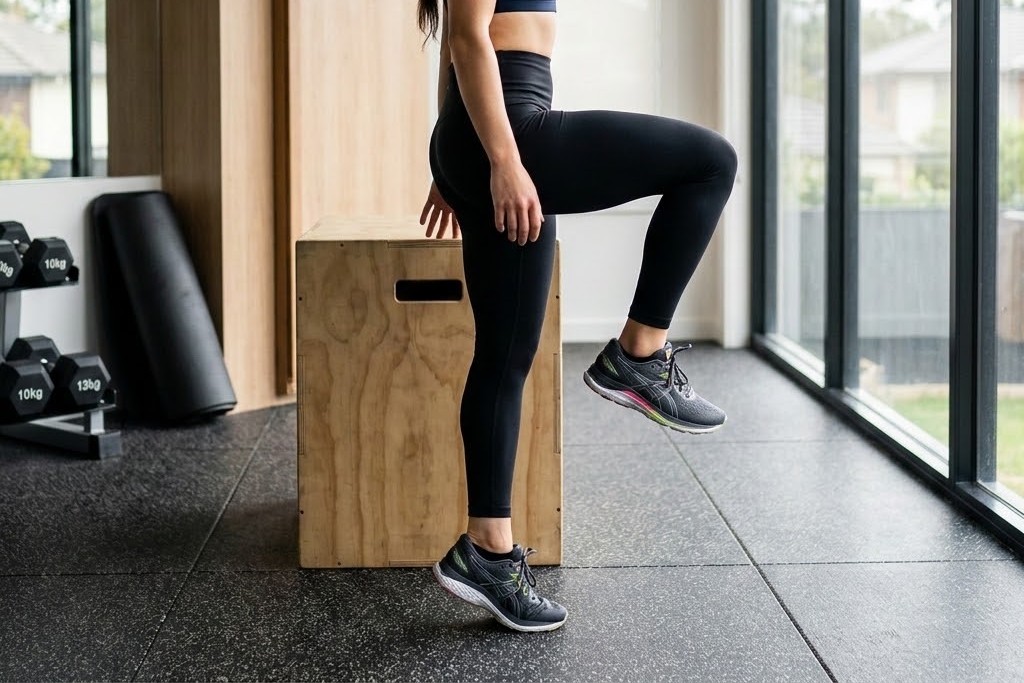
Targets: Quads (Thighs), Glutes, & Core Stability. Start standing tall. March one knee upward until your thigh is parallel to the ground. From this elevated position, step forward into a lunge, controlling your momentum as you land. Lower your back knee toward the floor, keeping your torso upright. Drive firmly through your front heel to stand back up, immediately marching the opposite leg forward.
Form Cue: If you are in a small room, simply turn around when you run out of space, but keep the stepping pattern continuous to maximize the endurance challenge.

3. Single-Leg Deadlift
Targets: Hamstrings & Glutes. Stand on one leg with your standing knee slightly bent. Hinge forward from your hips, reaching your hands toward the floor while at the same time raising your non-standing leg straight out behind you towards the sky.
Form Cue: Think of your head, torso, and ankle as a straight line. Keep your pelvis perfectly square to the floor rather than letting your hip open up to the side. Only lower yourself until you feel a deep stretch in the standing hamstring, then drive your hips forward to return to standing.

4. Bounding Jumps
Targets: Power & Eccentric Control. Stand with your feet hip-width apart and weight evenly distributed. Hinge your hips back into a shallow squat, and then powerfully explode forward, jumping as far as you can safely control.
Form Cue: The magic of this exercise happens during the landing. Focus on landing as quietly as possible, absorbing the impact evenly through both legs by absorbing the force and lowering into a shallow squat.


5. Single-Leg Squat
Targets: Core Stability & Quads (Thighs). This movement is the gold standard for assessing a runner's strength and stability. Stand on one leg with a sturdy chair or box behind you to serve as a target. Push your hips back and lower yourself under control toward the target, performing the squat motion with just the standing leg.
Form Cue: Keep your shoulder, hip, knee, and ankle aligned as you lower into the squat. Do not let your knee cave inward toward your big toe or shift your shoulder off to the side. If possible, gently hover just above the target before standing back up. Choose a target that is high enough for you to perform successfully, gradually lowering it as you get stronger.

6. Posterior-Medial Taps (Curtsy Reach)
Targets: Glutes & Lateral Hip Stabilizers. Stand on one leg. Keeping all of your weight centered on that side, bend your knee and reach your other leg diagonally behind you, lightly tapping the floor with your toe.
Form Cue: Imagine you are standing on a rock in the middle of a river; lightly tap your back toe into the water without falling in. You should feel the effort coming from the outside of your standing hip.
The Right Shoe Matters Too
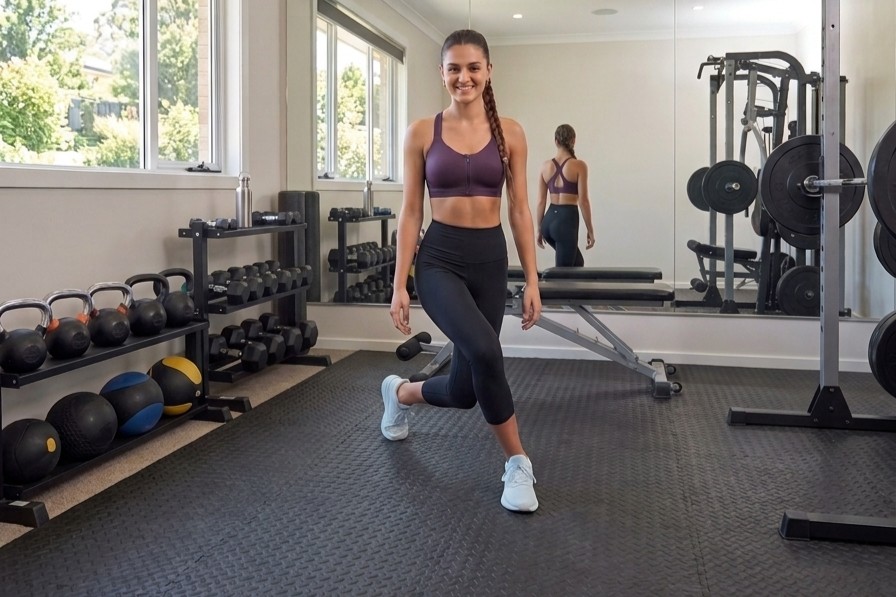
Building this kind of functional strength is only half the equation — the shoe you're standing in while you do it matters just as much. Running shoes are built for forward motion: a narrow platform and a flexible sole designed to carry you efficiently over long, straight distances. Training shoes are a different tool entirely. They're built with a wider base for lateral stability, more structure through the upper to support side-to-side movement, and an outsole designed for grip on indoor surfaces rather than pavement or trail.
If you're doing these exercises, you don't want to get hurt because you were in the wrong shoe. And the right training shoe isn't one-size-fits-all, either — a 200-lb runner with a wide foot and heavier build doing these exercises has different needs than a 150-lb runner with a narrow foot working with their own bodyweight. Your weight, foot shape, and goals all factor into what "right" actually means for you.
That's exactly what our Fit Process is built to solve. Take the fit test to match your biometrics and training goals to the shoe that's actually built for you — not just a generic recommendation.
Find Your Ideal Running Shoe
Strength training helps your body handle the miles, but the right running shoes make all the difference. Let us help you find footwear tailored to your unique biomechanics, structure, and running style.
Start Your Fit Scan