

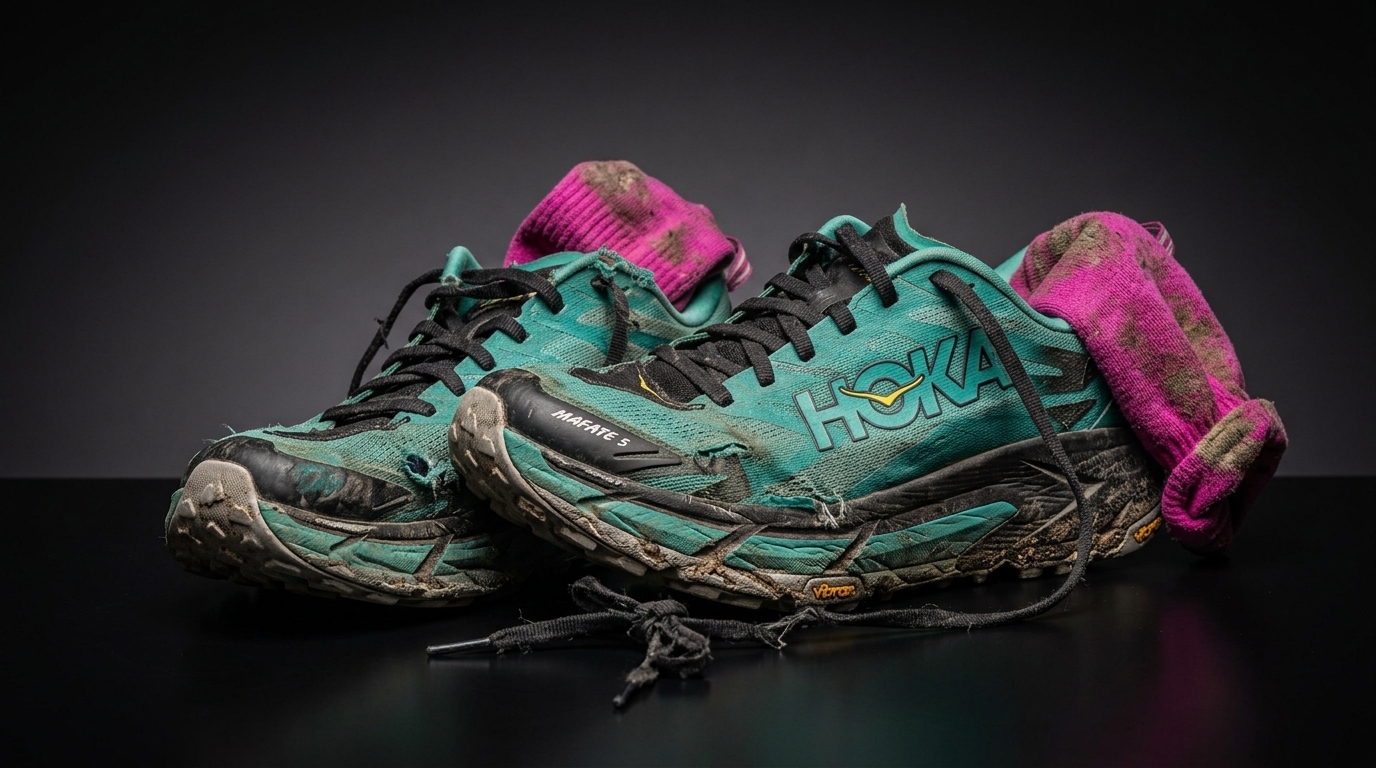
You've probably heard "replace your shoes every 400 to 600 miles." It's a fair starting point, but it's an average. The real answer depends on the shoe, the foam, and the biometrics of the runner/walker. The stakes are real. In a lab study of running-shoe midsoles, peak pressure under the heel roughly doubled after about 500 km (about 311 miles) of running, and the researchers flagged foam fatigue as a possible contributor to running injuries (Verdejo & Mills, 2004). Your shoes lose cushioning gradually, so you rarely notice it happening. Here's how to think about it.
What foam fatigue, your biometrics, and shoe rotation really tell you about when it's time for a new pair.
1. The Type of Shoe Matters Most
Not every shoe is built to last the same distance. There is a durability and performance trade off. The lighter and bouncier the shoe, the less mileage you'll get.
A. Daily trainers: about 400–600 miles — A typical training shoe uses denser foam and a thicker layer of outsole rubber (the tread on the bottom). It's built to take the daily grind, so it sits at the high end of the range.
Examples: Brooks Ghost 18 (Men's) (Women's), Asics GT-2000 15 (Men's) (Women's), HOKA Clifton 11 (Men's) (Women's)
B. Lightweight tempo shoes: about 200–400 miles — The foam is firmer and the outsole is minimal, so there's simply less shoe to wear down. They're built with less durability than a trainer.
Examples: Adidas Adizero Evo SL (Men's) (Women's), New Balance FuelCell Rebel v5 (Men's) (Women's), Saucony Endorphin Speed 5 (Men's) (Women's)
C. Carbon-plated race shoes: about 150–300 miles — Carbon-plated, super-foam racers (the Vaporfly, Adios Pro, and Metaspeed families, for example) typically give you about 150–300 miles, and many runners feel the "pop" fade toward the low end of that range. Racers use lighter, softer, more resilient foam and thin outsole rubber to save weight, so durability is traded for speed. The foam tends to lose its energy return before it visibly breaks down, which means the shoe can look fine and still be done.
Save your racers for race day and key workouts. Every easy mile in a racer uses up a limited supply. Many runners keep the miles under about 100–150 on the pair they want at peak performance.
2. Your Body Sets the Clock Too
Two runners can wear the same shoe and retire it 200 miles apart. A few things drive that:
Body weight relative to foot size. Your weight is spread across the surface of your foot, and a heavier runner in a smaller shoe loads the foam harder on every step. Foam that's compressed harder wears out sooner.
Stride length and cadence. A shorter stride means more steps, and more impacts, per mile. Two runners logging the same miles are not putting the same number of compressions into the shoe.
Cushioning needs. In a large randomized trial of 848 recreational runners, researchers found that the cushioning-and-injury relationship depended on body mass (Malisoux et al., 2020). The shoe that's right, and how long it stays right, depends on who's in it.
3. Foam Matters, and Newer Isn't Automatically Longer-Lasting
Traditional midsoles use EVA foam. Newer super foams, like PEBA, deliver more bounce at lower weight, and it's natural to assume that better tech means longer life. So far, the research points the other way.
In one 2024 study of trained runners, a PEBA-midsole shoe showed more wear over 450 km (about 280 miles) and a worse running economy than it had when new. The EVA-midsole shoe showed no change in running economy over the same distance (Rodrigo-Carranza et al., 2024). That's one study of a limited set of shoes. Foam technology is moving fast, and the science hasn't caught up.
Do Worn-Out Shoes Cause Injuries?
The honest answer is that we don't know for certain. Runners who log more miles wear out shoes faster, and they also get hurt more often, so it's hard to separate the two.
But common sense counts for something. Lab work shows that as cushioning fades, the pressure and load your body absorbs go up. A shoe that's stopped absorbing shock is handing more of that stress to your joints and muscles.
4 Ways to Protect Yourself
1. Get fit for your biometrics, preferences, and activity. A shoe that fits your foot, your body, and how you run is the one that will feel right, and last right, for you. That's exactly what the FMRS Fit Test is built to do.
2. Track your mileage. Log your miles in an app like Strava, or connect your account to FMRS and we'll let you know when your shoes are approaching the end of their life.
3. Rotate your shoes. Alternating pairs gives the foam time to recover between runs and varies the stress on your body. One study of 264 recreational runners found that those who used multiple pairs had a lower injury risk than those who ran in one (Malisoux et al., 2015). For a deeper look, read Dr. Isaac's article: Do Shoes Prevent Running Injuries?
4. Watch for the signs. Mileage is a guide, and your shoes will tell you the rest: visible creasing or compression lines in the midsole, uneven wear on the outsole, a shoe that feels flat or "dead," or new aches you can't explain.
Find Your Perfect Fit
Not sure which shoe matches how you run? Take the free FMRS Fit Test.
Start Your Fit Quiz