

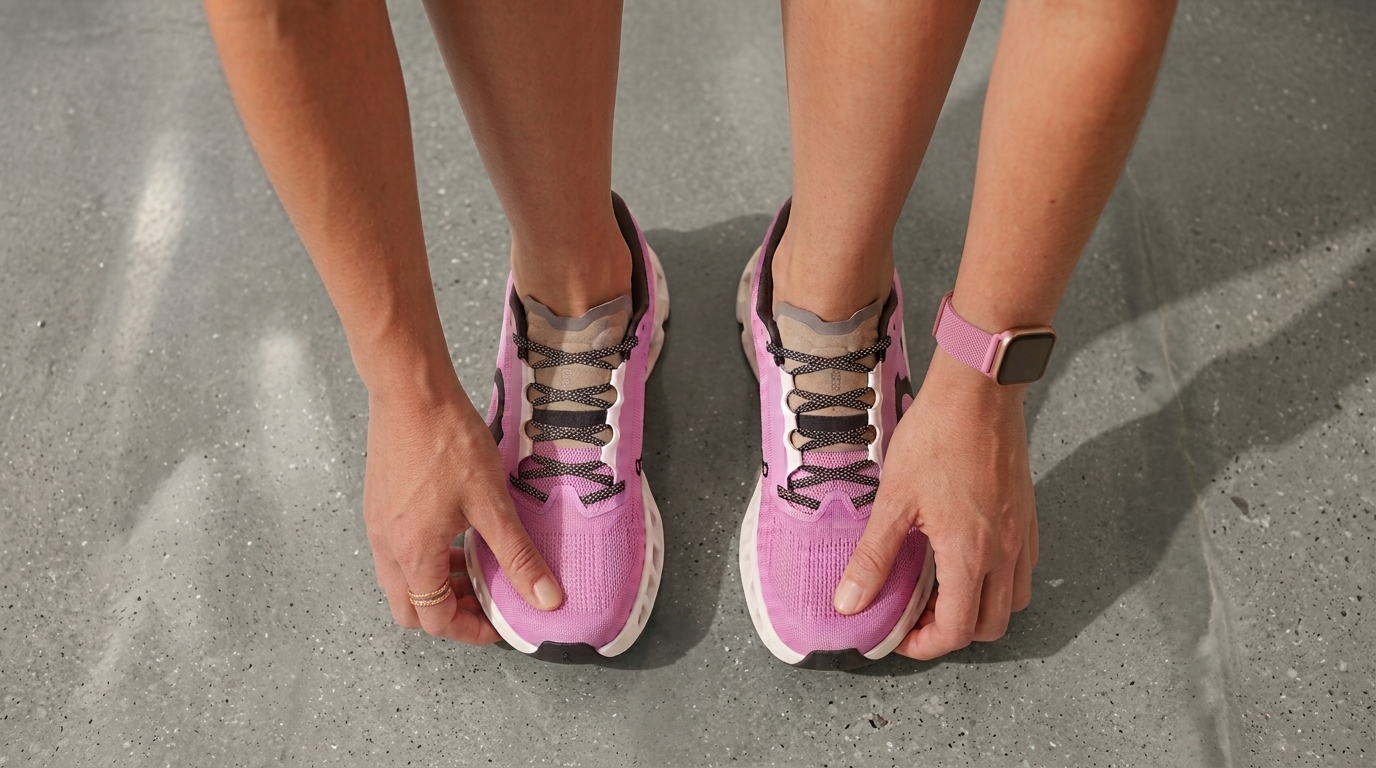

Your feet aren't the same size at 8 a.m. as they are at 6 p.m., and that single fact is where most people get running shoe fit wrong. So how should running shoes fit? It starts with when you try them on, not just what size you grab.
Your feet aren't the same size at 8 a.m. as they are at 6 p.m. Here's the timing mistake most runners make when buying shoes, plus the length and width rules that actually determine fit.
The Mistake: Trying On Shoes Too Early in the Day
Your feet retain fluid and swell as the day goes on. That's why Mayo Clinic podiatrists recommend shoe shopping late in the day, when swelling peaks, and Cleveland Clinic podiatrists say to get measured toward the end of the day. Harvard Health adds that hot weather can make feet swell even more.
That late-day foot is also the closest match to how your feet feel a few miles into a run. Fit the shoe to that foot, not your fresh morning one.
Try shoes on in the late afternoon, or right after a walk or run. Wear the socks you actually run in. A shoe that fits your feet in the morning will feel tight once they've swelled later in the day.
How Should Running and Walking Shoes Fit?
Timing gets you halfway there. The other half is knowing what "fits" means. It comes down to two things: length and width.
A. Length: The Thumbnail Rule
Mayo Clinic podiatrists recommend about half an inch of space between the end of your longest toe and the front of the shoe. A quick check while you're standing: that's roughly a thumbnail's worth of room.
Too short: Every stride pushes your toes into the front of the shoe. Over miles, that repeated impact causes black toenails, which is bruising under the nail.
Too long: Your foot has room to slide. You'll feel your heel slipping out of the back of the shoe, and that movement is what creates blisters.
Get measured every year. Your foot size isn't locked in at 18. According to Cleveland Clinic, as the ligaments and tendons that support your arch wear with use, the arch slowly flattens, and your foot gets a bit longer or wider. Weight gain adds to it, because extra pounds press down on those same supporting structures. Pregnancy can do it too: a University of Iowa study that followed 49 women through pregnancy found 60% to 70% had longer and wider feet afterward.
The size you wore five years ago may not be your size today. Use our tool to get measured.
B. Running Shoe Width Guide: Understanding B, D, and 2E
Length gets all the attention, but width matters just as much. Two checks:
Your toes should have room to spread. When your foot lands, your forefoot naturally splays. If your toes feel pinched or stacked together, the shoe is too narrow.
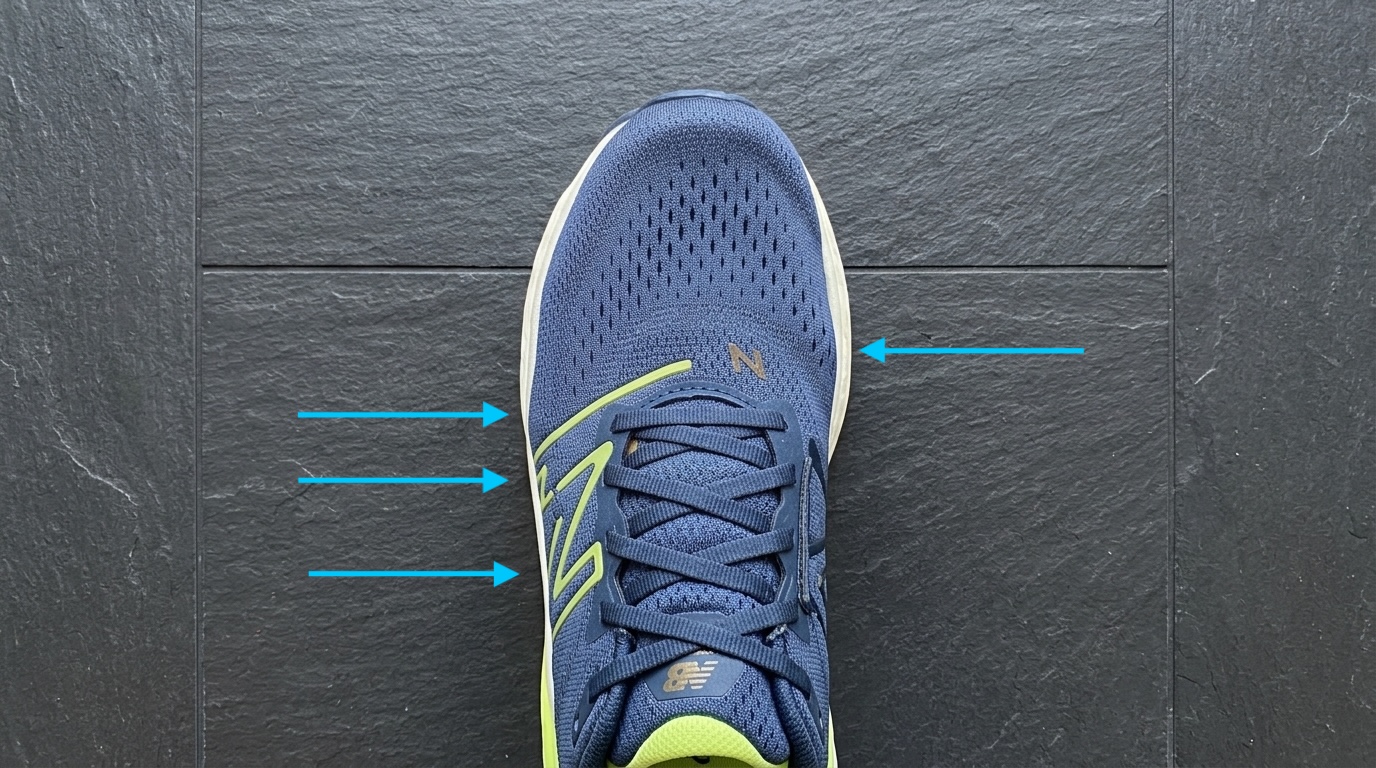
Your foot should sit on the platform, not over it. The platform is the footprint of the midsole, the foam base your foot rests on. Stand up and look down. If the sides of your foot are bulging over the edge and you can see the midsole sticking out beneath the upper, you're likely in the wrong width and should consider a wide size.
Width letters are different for men and women. This trips up a lot of people. Here's the standard system:
Men's: Narrow B · Medium D · Wide 2E · Extra Wide 4E
Women's: Narrow 2A · Medium B · Wide D · Extra Wide 2E
Notice that a men's narrow (B) is the same letter as a women's medium (B). Understanding that overlap gives you options if you're hard to fit.
Say you're a guy with a really narrow foot and a men's B still feels sloppy. You could look at a women's narrow, which is a 2A. It works the other way too: a woman with a wide foot who can't find a women's 2E in the shoe she wants may find a men's 2E. Just remember the size number changes when you cross over.
Real Examples: Shoes That Come in Wide
These are examples of what width options look like in the real world, not personalized recommendations. The right shoe for you depends on your foot, your stride, and your goals.
Road
- HOKA Clifton 11 (men's): Medium, Wide, and Extra Wide (2E)
- Brooks Glycerin 23 (women's): Medium, Wide, and Extra Wide
Trail
- Altra Lone Peak 9 (men's): Medium and Wide
- Brooks Ghost Trail (women's): Medium and Wide
As with length, get your width measured once a year. Feet can spread just as easily as they lengthen. Use our tool to get measured.
C. "I'm in a Wide and It Doesn't Feel Any Different"
If you've moved to a wide and it barely feels different from a medium, you're probably not imagining it.
Here's something I saw over years on the brand side. A true wide should be built on its own platform: a midsole that is actually wider underfoot, shaped to support a wider foot. That costs money. It means new molds, new tooling, and more development. So some brands save money by keeping the medium-width bottom and adding extra volume in the upper.
On the wall, it's labeled "wide." On your foot, the upper has more room, but you're still standing on a medium platform. Your foot still hangs over the edge, and the base still isn't supporting it the way it should. You got extra fabric instead of the stable, supportive base you actually needed.
If a wide shoe feels roomy on top but you can still see your foot spilling over the midsole, you're likely standing on a medium platform. Look for a wide that's built on its own wider base.
The Bottom Line
We've shared real shoe examples here because seeing actual width options makes all of this easier to understand. But no article can tell you which shoe is right for your foot. That depends on your biomechanics, your preferences, and your goals. You get there by being measured and properly fit.
That's exactly why we built our sizing tool. Get fit.
Try your shoes on late in the day. Give your toes about half an inch of room. Make sure your foot sits on the platform, not over it. And get measured every year, because your feet keep changing even when your shoe size doesn't.
What you run in matters.
Get Properly Fit
Measure your length and width in minutes, then find shoes that actually carry your size.
Use the Sizing Tool